Fabric is the only common laser material that is not a solid. It is a structure, built from fibres that are spun, woven, knitted, or bonded together, and it behaves like a flexible network rather than a sheet.
That structure is exactly why the laser performs so well on textiles, and also why it fails in ways that never appear on wood, acrylic, or MDF.
Because there is no mechanical contact, there is no crushing, no stretching, and no tool wear. Where a knife or die presses the material before it separates it, the beam simply vaporizes a narrow line of fibres and leaves the rest of the panel untouched.
On synthetic fabrics, the cut edge is simultaneously sealed. Fibre ends melt and fuse back together, so the edge does not fray, does not unravel, and does not need the overlocking or hemming that a knife cut would require.
On natural fabrics, the same process produces char instead of a clean seal, and the difference between those two outcomes is not a machine setting. It is the fibre chemistry of the material on the bed.
Fabrics fall into two broadly different groups under a CO₂ beam, and they should never be treated as one material.
Cellulosic and protein fibres — cotton, linen, viscose, wool, silk — are natural fibres. They char and discolor rather than melt. The cut edge stays porous, may yellow or brown, and can carry a faint burned odor. They are cuttable, but the edge is a burn line, not a sealed one.
Synthetic fibres — polyester, nylon, acrylic, elastane — melt. At the correct energy level they fuse into a clean, sealed edge, which is often the entire reason a buyer chooses a laser over a die cutter. Too much energy leaves a hard, brittle bead instead.
Blends behave as the sum of their parts and are the least predictable category, because the two fibre types want different things from the same pass.
| Fabric type | How it behaves under the beam | Best suited to | What to confirm first |
|---|---|---|---|
| Cotton and linen | Chars rather than melts; brown or yellow edge, porous cut line | Apparel sampling, home textiles, craft work | Whether a burn line is acceptable in the finished product |
| Polyester and nylon | Melts and self-seals; clean edge, sealed fibre ends | Sportswear, flags, banners, technical textiles | Whether the edge needs to be soft or may form a bead |
| Blends (cotton-poly, poly-elastane) | Mixed behaviour; unpredictable along the same cut | Cost-driven apparel production | Test on the actual blend, not on a single-fibre reference |
| Wool and silk | Chars, discolours, and produces a strong odour | Premium apparel, scarves, accessories | Ventilation capacity and whether discolouration is acceptable |
| Felt (synthetic) | Cuts cleanly, edges fuse | Craft, automotive trim, filtration | Fibre content; wool felt behaves differently |
| Technical and nonwoven fabrics | Usually cuts cleanly with a sealed edge | Filter media, geotextiles, industrial textiles | Fibre composition and any surface treatment |
| Coated, laminated, or backed fabric | Coatings can melt, flare, or release heavy fumes | Upholstery, outdoor textiles, automotive | Whether the coating or backing contains PVC |
| PVC-coated fabric | Not suitable for laser processing | — | Never cut on a laser; confirm composition before loading |
The final row is a hard rule, not a process preference. PVC-coated and vinyl-backed fabrics are widely used in upholstery and outdoor products, and chlorine-containing materials release corrosive, hazardous fumes that also damage the machine. Composition must be confirmed before the fabric reaches the bed.
Most difficulties in textile laser cutting come from the material's flexibility, not from its chemistry.
Fabric lifts when air assist flows across it. It curls where heat is applied. It shifts when the gantry accelerates. Thin, light fabrics are the worst case, and a single lifted area changes the focus distance and produces an inconsistent cut in the middle of an otherwise good job.
Solving that is a mechanical problem before it is a parameters problem:
Fabric is thin, so the energy needed per unit length is low. The productive question is not how much power is available, but how precisely that power can be held steady across a long, curved path.
| What you see | What usually causes it | Practical correction |
|---|---|---|
| Frayed or unsealed edge on synthetic fabric | Energy too low, or speed too high for the fibre | Increase energy slightly and retest the seal |
| Brown or yellow burn line on cotton or linen | Excess energy, or a slow pass | Raise speed; accept that natural fibres will not seal |
| Hard, brittle bead along the cut | Excess energy on synthetic fibre | Reduce energy, keep the traverse speed up |
| Inconsistent cut across one panel | Fabric lifted, curled, or shifted on the bed | Improve hold-down and reduce excess airflow |
| Cuts that follow the pattern but miss registration | Material moved between marking and cutting | Use a fixed carrier or a cut-to-print registration system |
| Soot or discolouration near the cut line | Smoke re-depositing on the surface | Increase extraction, check nozzle alignment and airflow direction |
| Cut edge opens up after washing | Sealed edge was incomplete | Re-establish the seal, not just the separation |
One advantage of textile laser processing is often underused: the same file can cut the outline, perforate a decorative pattern, mark notches and drill points, and apply a size or logo mark, all without tooling and in a single pass.
That changes what a short production run costs. There is no die to manufacture, no tooling changeover, and no minimum order volume imposed by a physical tool. Sampling and production use the same file, so the sample that was approved is the product that ships.
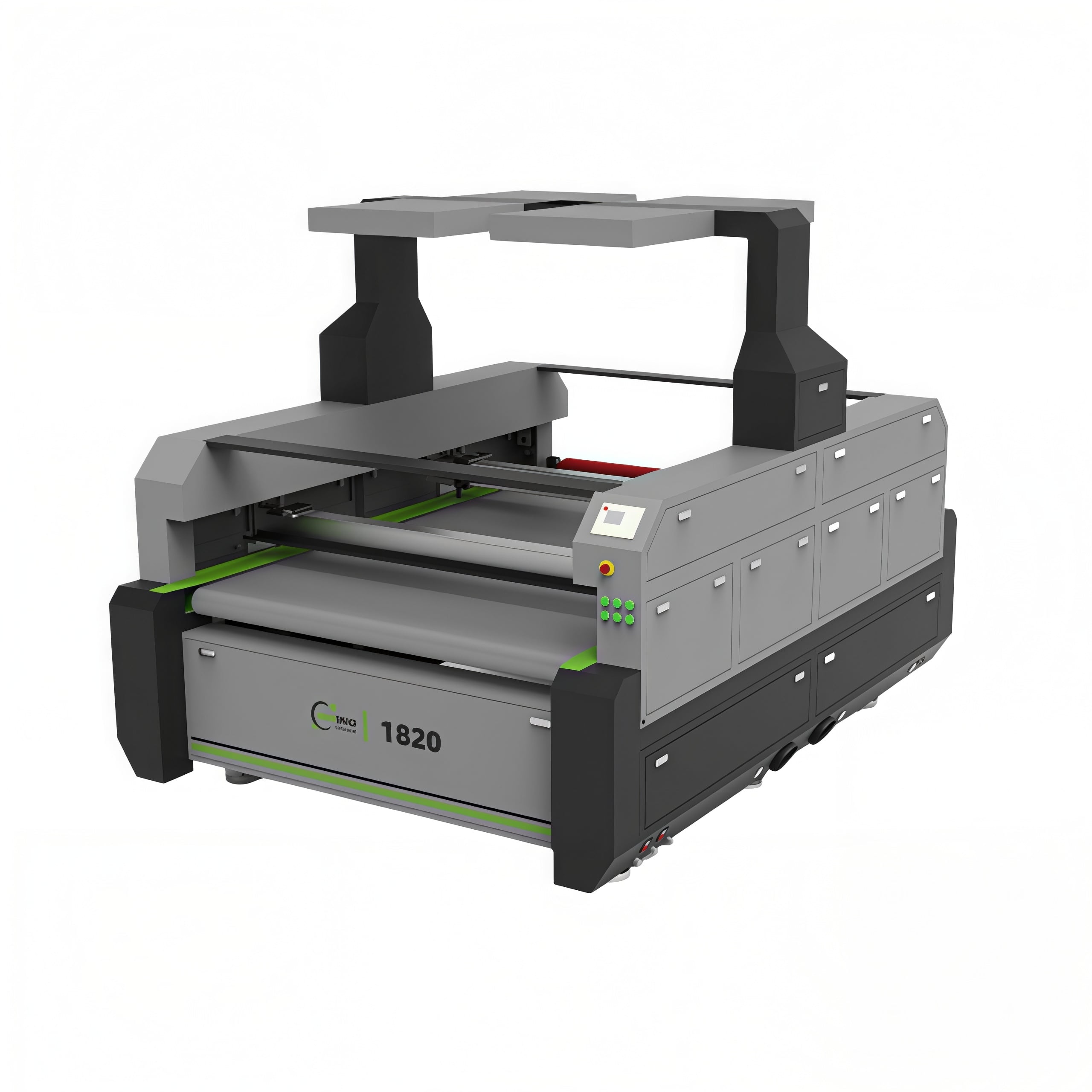
For printed or patterned fabric, a camera positioning system allows each cut to be registered against the printed design already on the material. This is the standard approach for cut-to-print work, where the outline must follow the printed pattern rather than the edge of the roll.
| Production goal | How the laser handles it | Note |
|---|---|---|
| Short runs and sampling | Same file for sample and production, no tooling | Design changes cost a file edit, not a new die |
| Cut-to-print patterns | Camera registration aligns each cut to the print | Confirm registration marks are included in the artwork |
| Perforation and decorative cutting | Low-energy passes create vent or lace effects | Test the perforation strength on the actual fabric |
| Notches, drill points, and labels | Marked in the same pass as the cut | Reduces secondary handling and manual marking |
| Multi-layer cutting | Several plies cut at once to increase output | Establish layer count by test, not assumption |
Textile processing concentrates three risks.
Fumes. Synthetic fibres and, above all, coated or backed fabrics release fumes that must be captured at the source and either exhausted outside or passed through proper filtration. PVC-coated fabric must never be laser processed, and the same applies to any fabric whose coating chemistry is unknown.
Fire load. Fabric offcuts, lint, and char collect in the bed and ducting. Lint is among the most easily ignited materials in a laser workshop, and it accumulates where it is least visible.
Material identity. Fire-retardant treatments, coatings, and backings are common in furnishing and technical textiles, and they change both the fume profile and the cutting behaviour. Composition should be confirmed from the supplier, not inferred from the product name or appearance.
The routine is the same as for any combustible material: never run unattended, keep the bed and extraction path clean, verify airflow before a long production run, and hold the material flat so that the beam does the cutting rather than the fabric's own heat.
Most textile scrap is not a machine fault. It comes from treating a flexible, chemically varied material as a single known quantity.
| Checkpoint | Why it matters | Practical action |
|---|---|---|
| Fibre composition | Decides charring versus sealing | Confirm composition with the supplier, not the product name |
| Coating or backing chemistry | Determines fume risk and laser suitability | Confirm before loading; PVC is a hard no |
| Fabric weight and drape | Drives hold-down and airflow settings | Test the hold-down before a production run |
| Layer count and stack height | Changes energy reaching the lower plies | Establish by test for each fabric |
| Focus height uniformity | Lifted fabric breaks focus mid-job | Verify the material stays flat across the whole panel |
| Extraction performance | Protects the operator and the cut edge | Check airflow before every long run |
| Lint and bed cleanliness | Directly linked to fire risk | Clean the bed and ducting on a fixed schedule |
Textile production rewards machines that combine a large working area, steady traverse speed, and clean material handling.
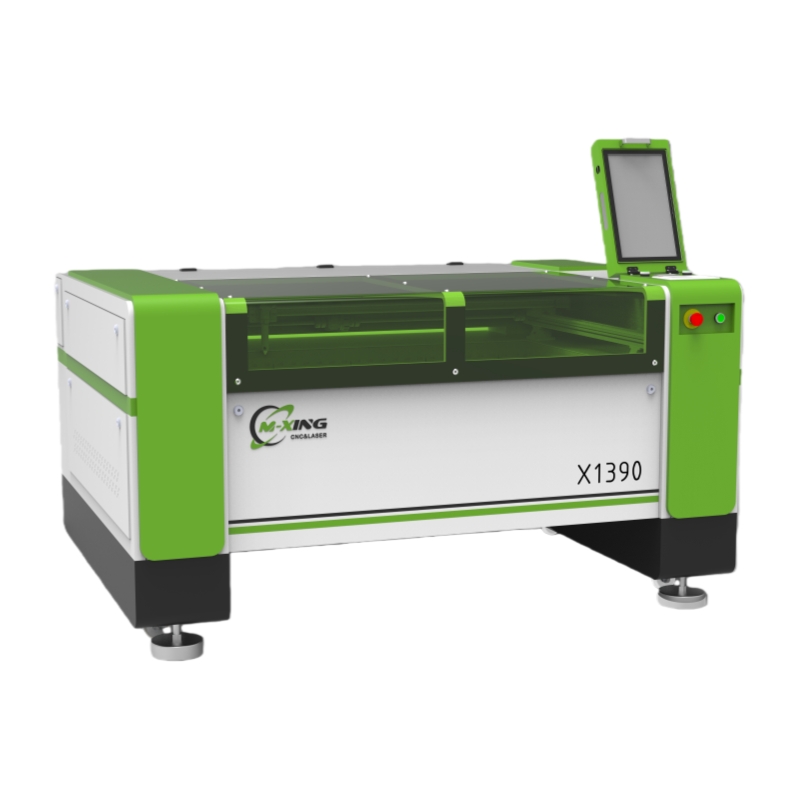
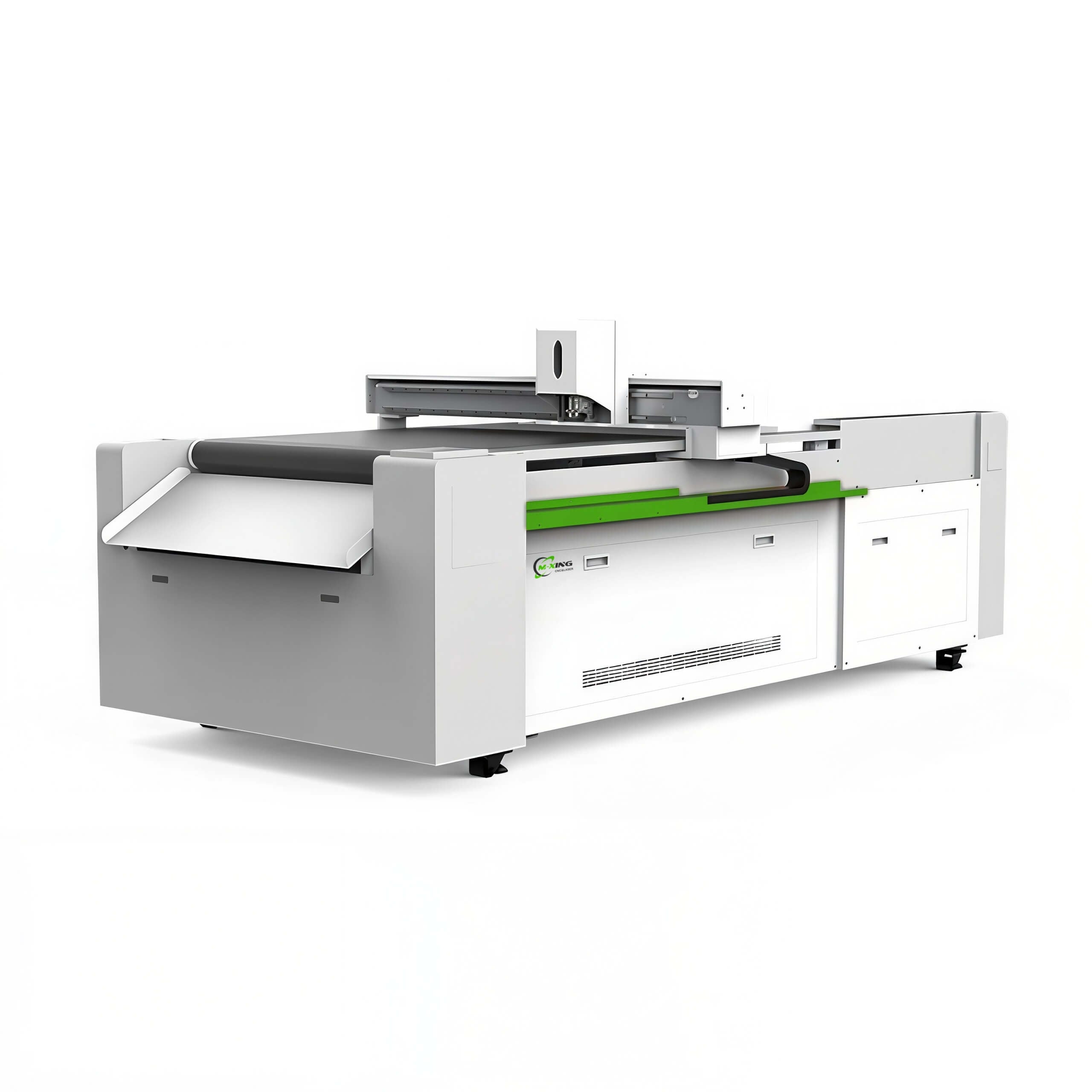
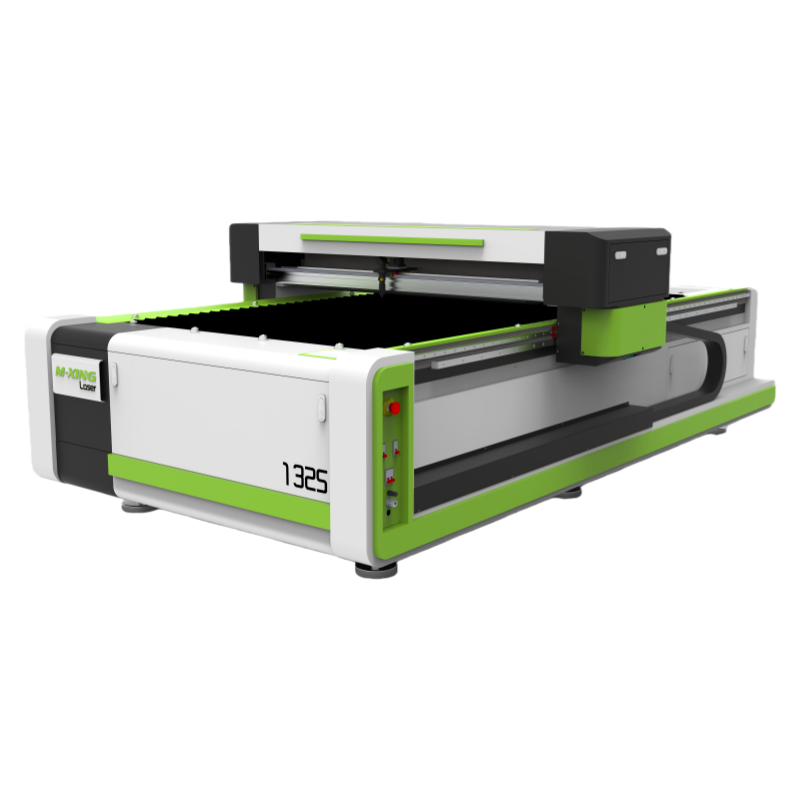
Working area and feeding method. Fabric arrives either as panels or as rolls. Mingxing Laser offers flatbed formats across the 6090, 1390, 1610, and 1325 sizes, and the product range also includes automatic feeding laser cutting machines for roll-fed textile work, so the machine format can follow the material rather than the other way round.
Traverse speed consistency. Long, curved apparel patterns are the hardest case for a motion system, because heat sealing depends on uniform speed. On the X1325 magnetic levitation platform, an X/Y-axis linear motor system delivers a maximum rapid travel speed of up to 1 m/s with repeat positioning accuracy of up to 0.05 mm, which supports uniform speed through curved and detailed paths.
Power control. Textile cutting needs precision at low energy rather than maximum output; the standard 100W, 130W, and 150W configurations are matched to the material by controlling the delivered energy, not by running at the top of the range.
Registration. For printed and patterned fabric, a camera positioning system registers each cut to the design on the material, which is what makes cut-to-print production practical.
Throughput. For repetitive components such as panels, trims, and small pattern pieces, a double beam configuration allows two operations to run in parallel on the same platform.
Extraction. Textiles generate smoke, lint, and residue, so extraction should be sized to the material and the duty cycle rather than treated as an accessory.
The configuration details above are taken from the published product and technical documentation for the respective models. Final selection should be based on fabric type, roll or panel format, and daily output.
Clean fabric laser cutting comes down to three decisions: identify the fibre correctly, hold the material flat and stable through the whole job, and control smoke before it reaches the surface.
Recognise that natural fibres char while synthetic fibres seal, size the hold-down and airflow to the actual fabric, and establish layer counts and energy by test rather than assumption. Those three steps solve most fraying, discolouration, and inconsistency problems before they reach a customer.
For workshops moving into textile production, the most useful first step is the simplest: build a small reference library from offcuts of each fabric used, record the seal quality and edge appearance for each, and stop repeating the same test on every new order.
 Hot News
2026-02-05
2026-02-03
2025-12-01

Mingxing Laser is a leading China-based laser machine manufacturer offering CO2 laser cutters, fiber laser cutting machines, CNC routers, laser welders & marking machines. OEM/ODM custom solutions available. Get a quote today!
- Company Headquarters: Room 1303, Building 4, UnitedFortune Plaza, High-tech Zone, Jinan City, Shandong Province, China
- Manufacturing Plant: No. 18, Yinhe Road, Jibei Street, Jiyang District, Jinan City, Shandong Province, China
Copyright © 2026 Century Mingxing (jinan) Intelligent Technology Co., Ltd. All rights reserved. Privacy Policy

 EN