Most buying decisions focus on the laser: tube power, bed size, motion system. Then the machine arrives, gets connected to whatever compressor and ducting happened to be in the building, and never performs the way the demonstration did.
The laser is a heat source. Air assist and extraction are the process control wrapped around that heat source, and they decide four things that show up in every job:
None of this is optional equipment in any meaningful sense. A laser with inadequate air and extraction is running at a fraction of its capability, and the operator usually blames the machine.
Air assist is doing three jobs at once, and it helps to separate them because each one has a different failure mode.
Clearing the kerf. On acrylic the material leaves as vapour; on MDF and board it leaves as char and dust; on fabric it leaves as melt. In every case the jet has to move that material out of the cut before it settles. Weak air leaves a resolidified bead on the underside and a smoky edge.
Cooling the cut zone. On wood, paper and board, air reduces secondary burning and keeps the char line narrow. This is why the same power setting produces a clean edge on one machine and a scorched one on another: the air was different.
Protecting the lens. A nozzle with positive pressure pushes debris away from the lens aperture. A dirty lens absorbs energy, heats up, and eventually fails — which is why lens contamination is so often a symptom of an air problem rather than a cleaning problem.
What air cannot fix is equally important. It will not compensate for wrong focus, wrong power, an unlevel bed, a warped sheet, or a material that should not be on the machine at all. Adding air to a badly set job just makes a bad cut cleaner-looking on the surface.
Excess air has its own costs. It lifts light materials such as fabric and thin paper off the bed, chills the cut so the kerf does not clear properly, drives embers into the extraction duct, and creates turbulence that deposits debris in places the operator never cleans.
Air supply is where the most expensive mistakes are made, because two numbers that look similar are actually different requirements.
Pressure and flow are not interchangeable. A compressor can deliver high pressure through a small orifice and still move very little air. What the nozzle needs is a specific flow at a specific pressure, and the two are set by the nozzle orifice and the material being cut. A machine rated for thick MDF needs more clearing capacity than one cutting paper, even if both use the same head.
The specification comes from the machine, not from the compressor catalogue. Start with the nozzle and recommended supply in the machine documentation, then verify it at the nozzle with a flow meter. Measuring at the compressor outlet tells you nothing about what reaches the cut.
Duty cycle decides whether the compressor survives production. Compressors are rated for intermittent or continuous duty. A small workshop compressor that is fine for a hobby will overheat and cut out in the middle of a production shift. Production cutting needs a compressor rated for continuous running, or a blower designed for the duty.
Receiver volume buffers the demand. The tank is not there to store air for the day; it is there to absorb the moment when the nozzle opens and demand jumps. An undersized tank means the compressor cycles constantly, runs hot, and shortens its life.
Size for simultaneous draw. Two heads, a second machine, or air also used for cleaning and blow-off all add up. Size the supply for the sum, not for one nozzle.
Dry, oil-free air is part of the specification. Water and oil travel with the air, reach the nozzle, and end up on the lens and in the cut. A filter-regulator unit at the machine, a dryer upstream, and a drained tank are not accessories — they are what makes the pressure specification meaningful.
One practical rule covers most of this section: measure at the nozzle, and size for the worst simultaneous demand rather than the average.
Extraction fails more often from duct design than from a weak fan. A fan can only move what the duct lets it move.
Capture at the source. Extraction works when it captures smoke at the head, not when it clears the room afterwards. A well-fitted shroud at the nozzle and a short run to the fan will outperform a much larger fan pulling through a long, leaky duct.
Duct diameter sets velocity, and velocity sets whether dust settles. Undersized duct gives high velocity but low volume and a noisy, strained fan. Oversized duct gives low velocity, and the material being extracted — MDF dust, cardboard dust, fabric lint — settles out and builds up on the bottom of the run. The duct must stay above the settling velocity for the material in question, which is why the same duct can work for one material and clog on another.
Every bend costs you. Elbows, long horizontal runs, and flexible corrugated hose all add resistance. Flexible hose is convenient at the machine end, but a long flexible run traps debris and reduces flow dramatically. Keep runs short, use gradual bends rather than tight elbows, and support horizontal runs so they do not sag into traps.
Make-up air is not optional. A machine in a sealed room cannot extract, because there is no replacement air to move in. If the door has to be closed for noise, the room needs a dedicated make-up air path, or the extraction will lose effectiveness as soon as the door shuts.
Where the air goes matters. Exhaust should not discharge next to a window, an air intake, or a neighbouring unit's fresh air. Check local requirements before fixing the outlet position.
Clean the duct. Ducts accumulate char, dust and condensed fume, and that lining is a fire path as well as a flow restriction. A duct that has never been opened is a duct nobody knows the condition of.
Recirculating filtration solves a real problem — a machine in a room without an external wall — but it only works if the filter stack matches the material.
Wood and MDF dust needs mechanical filtration and a large dust capacity. The pre-filter loads quickly, and a loaded pre-filter is the usual reason a "working" system stops clearing smoke.
Plastic fume is not dust. It condenses on cold surfaces, so it needs a filter medium that can hold condensate without collapsing, plus a chemical stage for odour and volatiles. A dust filter alone will pass the smell and load unevenly.
Leather and rubber produce heavy smoke with strong odour, which is a chemical-stage problem more than a particulate one.
Glass and ceramic dust is fine and abrasive. It loads filters quickly and is best extracted rather than recirculated.
Coated and laminated materials can release compounds that the filter was never designed for. This is another reason material identification belongs before the job, not after.
A practical filter stack has stages: a coarse pre-filter to protect the rest, a main fine filter, a chemical or carbon stage for odour and volatiles, and a final filter if the air is returned to the room. The exact sequence depends on the material mix, which is why a system bought for wood dust often underperforms the moment the shop starts cutting plastic.
Change filters on pressure, not on the calendar. A differential pressure gauge across the filter bank tells the operator when the filter is loading. Without it, filters are changed either too late, when flow has already collapsed and cut quality has been blamed on the laser, or too early, which wastes money. If a gauge is not fitted, a simple flow check at the head at the start of each shift is the next best indicator.
Never recirculate fumes from a material on the never-cut list. In practice this should never arise, because the material should not be on the machine; but filtration design is a useful reminder of why that rule exists.
The same machine may cut wood in the morning, acrylic in the afternoon and fabric in the evening, and each material wants a different balance. This is the table worth keeping next to the control panel.
Two patterns stand out. Materials that produce dust need extraction volume and duct velocity; materials that produce vapour need filtration chemistry and optics cleaning. A shop that cuts both needs a system designed for both, not one sized for whichever material came first.
Most of these are a one-time engineering decision plus a maintenance habit. The expensive ones are the first and the last: guessing the air supply, and never recording what worked.
Air and extraction are part of the machine specification, so they should be part of the purchase decision rather than an afterthought.
Two numbers to ask for. The nozzle or air-assist specification, and the extraction port diameter with its recommended flow. Those two figures determine the compressor, the duct and the filter — and they are much harder to change later than the laser tube.
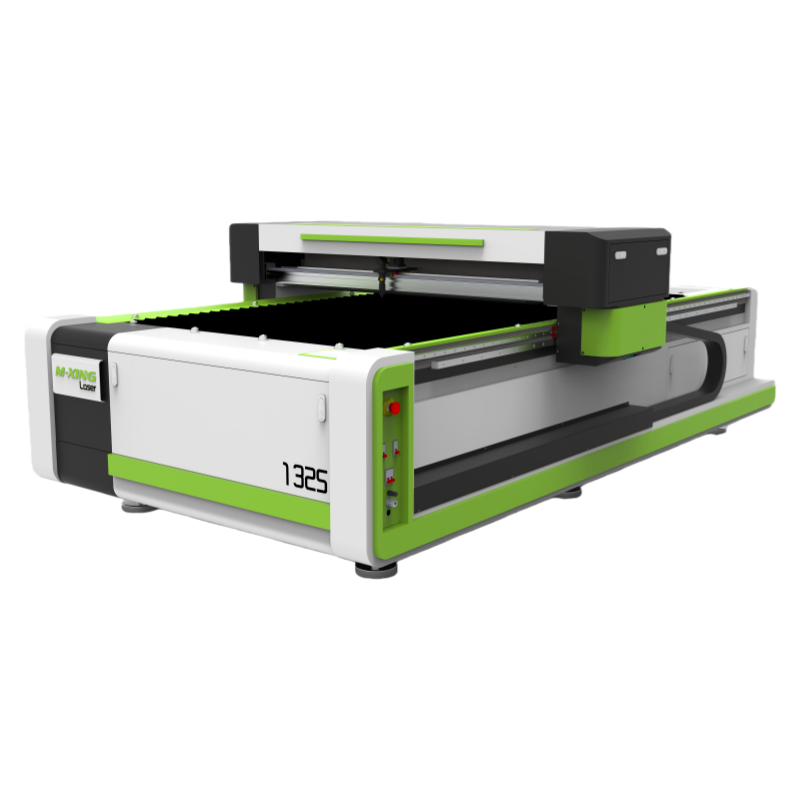
Bed size changes extraction design. A larger bed has more open area, so capture at the head matters more and zoning becomes useful: extracting only the zone in use keeps velocity up where it is needed instead of diluting it across a wide table. On the 1325 and 1610 formats, zoning and shroud design deserve as much attention as the fan rating; on a 6090, a well-fitted single-point shroud is usually sufficient.
Power configuration is not the constraint. Configurations across the 6090, 1390 and 1610 platforms are offered from 100W to 150W, and air and extraction requirements scale with the material and the nozzle, not with the wattage. A higher-power machine cutting thick MDF will need more clearing capacity than a lower-power machine cutting paper, but that is a materials question, not a power question.
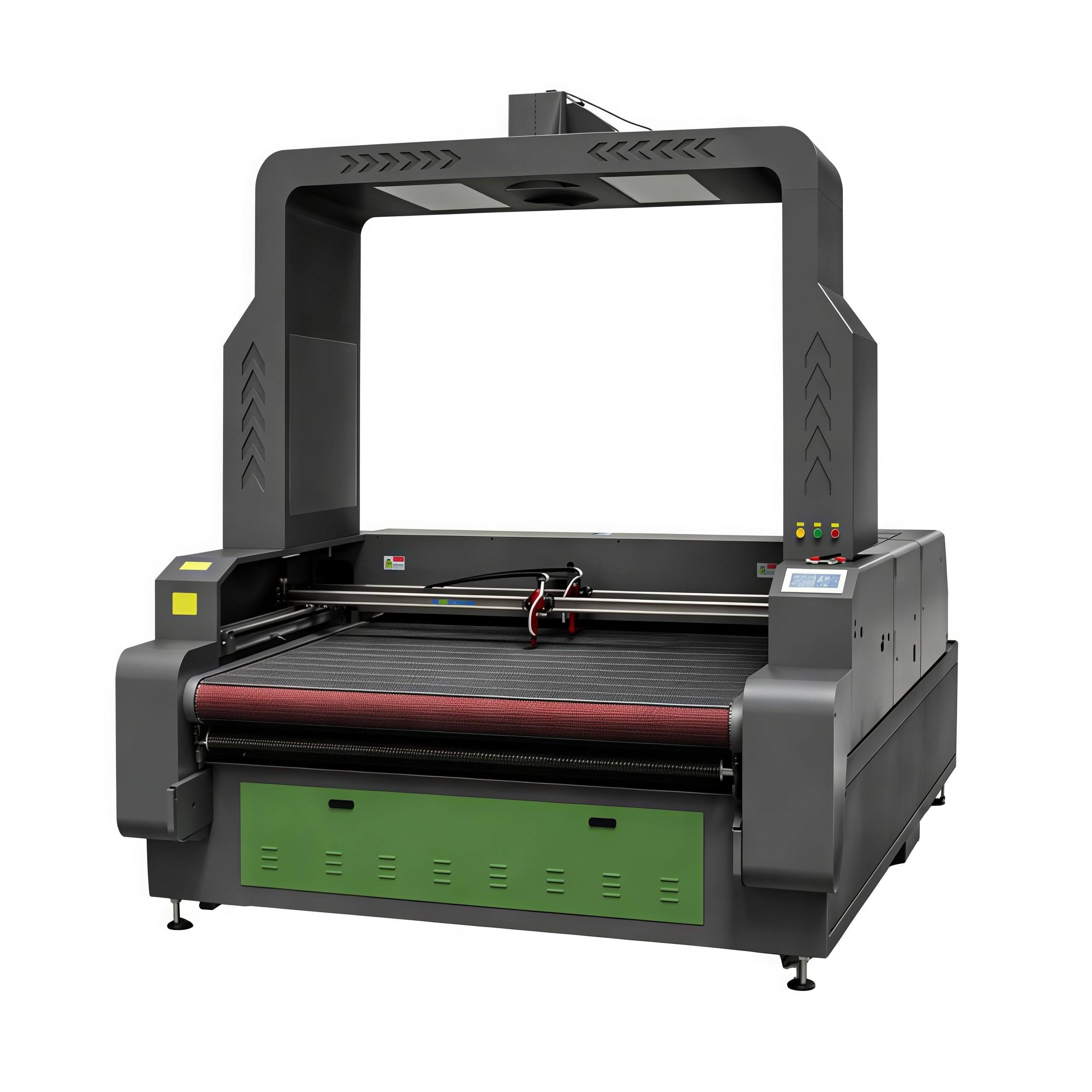
Dual-head and camera configurations add air demand and duct complexity. Two heads mean two nozzles drawing simultaneously, and a camera system adds another reason to keep the optics path clean. Size the supply for the installed configuration, not for the base machine.
Ask what is included. Some packages include a compressor and an exhaust fan; others include only the regulator and the duct port. Knowing which parts are in the crate prevents the common outcome where the machine is installed and the air system is improvised from whatever was in the workshop.
Air and extraction are the least glamorous part of a laser installation and the most reliable predictor of whether the machine performs to its specification.
The rules are simple enough to audit in an afternoon. Measure air at the nozzle and size the compressor for continuous duty with dry, oil-free air. Design ductwork for capture at the source, with velocity high enough that the material does not settle, and give the room a make-up air path. Match the filter stack to the material rather than to the dust you cut first, and change filters on pressure rather than on a calendar. Record the air setting for each material, because the next operator will not guess it correctly.
Do that, and the laser behaves the way it did in the demonstration. Skip it, and every other part of the process — optics, focus, power, motion — gets blamed for a problem that starts at the compressor.
 Hot News
2026-02-05
2026-02-03
2025-12-01

Mingxing Laser is a leading China-based laser machine manufacturer offering CO2 laser cutters, fiber laser cutting machines, CNC routers, laser welders & marking machines. OEM/ODM custom solutions available. Get a quote today!
- Company Headquarters: Room 1303, Building 4, UnitedFortune Plaza, High-tech Zone, Jinan City, Shandong Province, China
- Manufacturing Plant: No. 18, Yinhe Road, Jibei Street, Jiyang District, Jinan City, Shandong Province, China
Copyright © 2026 Century Mingxing (jinan) Intelligent Technology Co., Ltd. All rights reserved. Privacy Policy

 EN