Automotive interiors are not one market. They are a supply chain with sharply different rules at each level, and putting a laser in the wrong level is the most common expensive mistake in this segment.
Tier 1 supplies complete modules — a full instrument panel, a door cassette, a seat — to the vehicle manufacturer. Their production is die-based, their processes are validated, and their change control is measured in months. A laser is used there for prototyping and for low-volume or special-edition work, not for mainstream volume.
Tier 2 and Tier 3 make the components: skins, foam, felt, fabric covers, small trim parts. This is where a laser becomes genuinely useful, because these suppliers face frequent variant changes in modest volumes.
Aftermarket, custom and restoration shops re-trim vehicles, build ambulances and specialist vehicles, and produce small series. For them, tooling cost is the deciding factor and a laser is close to ideal.
Reading the table honestly: this is an industry where the laser's role is flexibility under variant pressure, exactly like apparel and packaging, and where the volume work belongs to other processes. The difference is that here, a mistake can also be a safety failure — which is why the next section matters more than any other in this series.
On a modern instrument panel or seat, the airbag deploys through the trim. To make that possible, the skin carries a tear seam — a line of deliberately weakened material that opens predictably when the airbag fires.
A laser is one of the established ways to create that weakening: a controlled partial-depth score on the back of the skin, following a defined path.
It is also the single most dangerous thing in this article, because the seam's behaviour is a safety function, not a cosmetic one. Three things must be true before anyone cuts one, and none of them can be supplied by a machine supplier:
The geometry comes from the customer's specification. The path, the depth, the residual wall thickness and the seam profile are defined by the airbag module design and validated against deployment behaviour. They are not values to be found in a machine manual, and they are not transferable between parts.
The process must be validated, not just repeatable. A validated seam is one whose behaviour has been demonstrated across the production spread — material batches, thickness variation, ageing, temperature. A machine that repeats the same motion is a precondition, not a validation.
Traceability is part of the product. Safety components carry records. A shop cutting tear seams needs a process it can document, not just a good result on the bench.
The responsible position for a machine builder is therefore narrow and unambiguous: provide the capability to hold a consistent partial-depth score, and decline to specify the seam. Any supplier who offers "the settings for an airbag seam" is either misunderstanding the requirement or overstating what a machine can guarantee. A shop taking on this work should insist on the customer's specification in writing, and should expect to prove its process rather than assume it.
Where a laser is genuinely valuable is upstream of validation: cutting prototype skins for deployment trials, and producing the iteration sets that let the geometry be developed. That is a legitimate and useful role, and it does not require anyone to certify a safety part.
Away from the safety-critical edge, perforation is what most automotive interior laser work actually is — and it is a good business.
Door panel skins, speaker grilles, headliners, seat centre panels and console trims all carry perforation, for acoustics, ventilation or appearance. The requirements are consistent and demanding:
Pattern consistency across a set. A pair of door panels, or four seats, must look identical. A die delivers that automatically; a laser delivers it if the file and the material handling are right.
Hole edge quality on leather and synthetic leather. A laser seals the edge of a synthetic, which prevents fraying and gives a clean look. On genuine leather the same heat produces a darker, harder rim — acceptable, and in some designs wanted, but it must be consistent.
Alignment to the part, not to the sheet. Perforation usually has to sit within a boundary — a stitched panel edge, a moulded feature. That means registration to the actual part, which is where a camera or a physical jig earns its place.
Backing and laminate behaviour. Many skins are laminated to foam. Perforating through the skin and into the foam changes acoustics and can leave loose foam debris in the holes; the process has to define whether the foam is cut, pierced or left intact.
Automotive interior materials are their own family, and the differences matter more here than in furniture or footwear because the parts are visible, touched and long-lived.
Genuine leather cuts and perforates well, with a charred rim that is normal and can be controlled. Its variability is the issue: hide-to-hide differences in thickness and finish mean a process proven on one batch may not transfer.
Polyurethane synthetic leather (PU) is the common automotive substitute. It cuts cleanly and seals at the edge, which is an advantage for perforation.
PVC synthetic leather is the trap. It releases hydrogen chloride when cut, which corrodes the machine and harms operators. It is still present in some low-cost trim and aftermarket products, frequently sold under a generic name.
TPO and PP skins behave as plastics rather than as leathers: they cut, but the edge finish and the fume load differ, and thin thermoformed skins are usually shaped, not flat, which puts them outside a flatbed laser's reach.
The rule for any interior shop: identify the material from its data sheet before cutting, every time. In automotive trim, "leather" can mean four different materials, and two of them are not safe to cut without proper controls.
Noise, vibration and harshness components are the least glamorous and most reliably profitable laser work in automotive interiors.
Seat bolsters, headliner substrates, carpet underlay, dash insulators and door watershields are all cut from foam, felt, nonwoven or foam-fabric laminates. Their shapes are complex, their volumes are often modest, and a die per variant is expensive.
This is the same economics as packaging inserts: low volume plus complex shape plus frequent change equals laser. The practical requirements are unglamorous but decisive:
The commercial heart of laser work in this industry is not the production line; it is the work that a die cannot economically serve.
Prototype and validation builds. Skins and trim for test vehicles, in small numbers, revised repeatedly. A laser turns a two-week die order into an afternoon.
Custom and specialist vehicles. Ambulances, hearses, police vehicles, motorhomes and conversion vans all need interior parts in single figures, in shapes that no standard part covers.
Restoration. A trim piece for a vehicle that has not been made for decades exists as a drawing, a photograph, or a surviving original. Cutting it from a scan or a traced outline is exactly what a laser is for.
Small-series and special editions. A manufacturer's limited run, or an aftermarket styling kit, where the volume is real but the tooling budget is not.
In all four, the value proposition is identical to the rest of this series: no tooling, instant revision, and the ability to make one part as easily as fifty.
Automotive work is documented work. Where a laser helps is in marking parts so they cannot be mixed, and in marking them where the mark will not be seen.
Part and variant identification engraved on a hidden face — a convention that removes an entire class of assembly error in a shop running several variants of similar parts.
Pair and set matching, so that a left and right, or four seat panels, stay together through trimming and fitting.
Assembly aids: alignment marks for stitching or adhesive, on faces that will be covered.
Three cautions. The mark must be on a face that is never visible in the finished vehicle, because a scorched number on a visible surface is a defect that cannot be corrected. The mark must survive the downstream process — adhesives, heat and cleaning can remove a shallow mark. And marking is not a substitute for the paperwork that automotive customers require; it is a production aid alongside it.
Automotive interior parts are flat, moderately sized, frequently laminated and often required in sets — which shapes the machine choice.
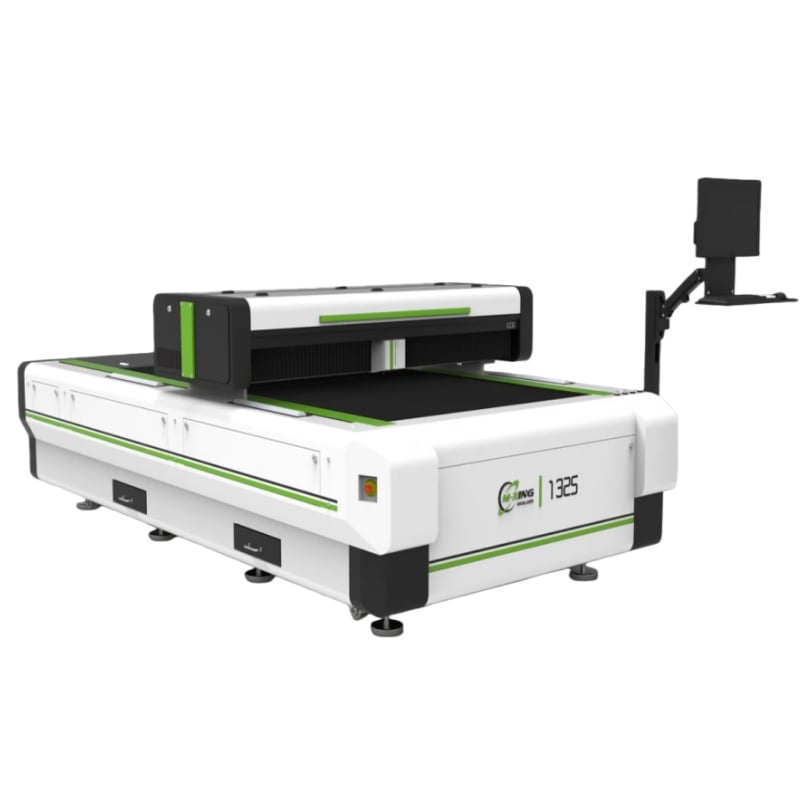
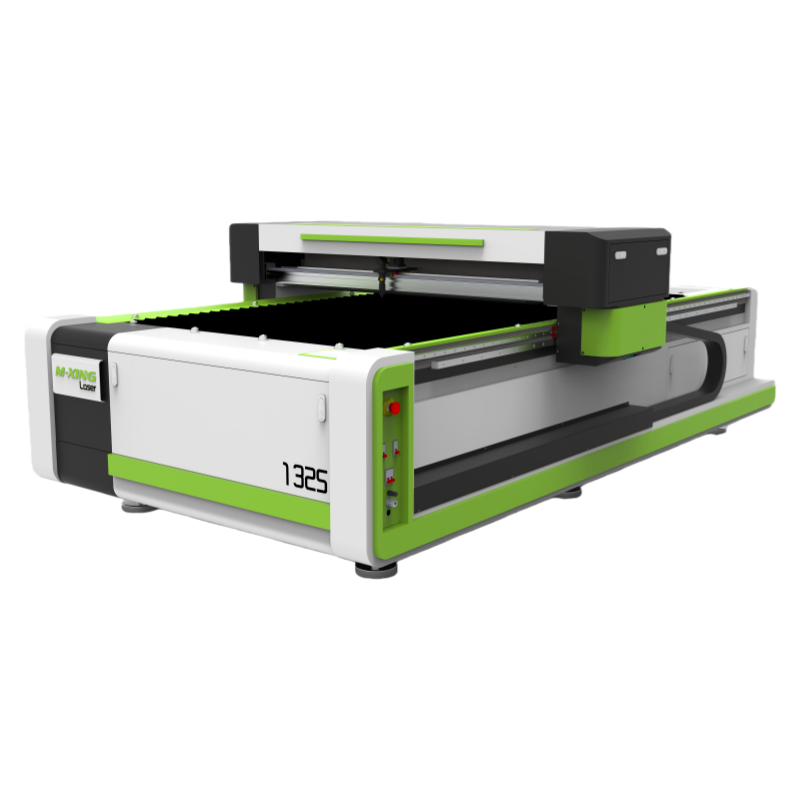
A bed that takes a full skin or several parts at once is the practical requirement, because sets must be cut in one setup to stay matched. The 1610 and 1325 formats suit full skins and nested sets; the 1390 covers smaller trim and perforation work.
Registration is the feature that decides capability. Perforation that must respect a stitched edge, or a pattern that must sit within a moulded boundary, needs a camera or a well-made jig. Without one of the two, every job becomes a skilled manual setup.
Extraction has to handle laminate fume, which is heavier and more persistent than plain leather or textile smoke, and which changes with every material in the table above.
Depth control matters if partial-depth work is planned — not for safety-critical seams, which belong to a validated process, but for decorative scoring and for controlled perforation into laminates.
The honest summary for a customer in this industry: a laser gives you variant flexibility and tooling-free sampling, in a market where both are worth money. It does not give you a validated safety component, a formed three-dimensional skin, or a substitute for the process documentation your customer will ask for.
Automotive interiors reward a laser in the tier where variants outnumber volumes: component suppliers making skins, foam and felt in modest batches, and the aftermarket and specialist builders who cannot justify a die for a handful of parts.
They punish it where the rules are strictest. A tear seam is a safety function defined by the vehicle's engineering, not a cutting parameter — and any shop entering that work should insist on a written specification and expect to validate, not to guess.
Everything in between — perforation, foam, trim, marking, prototypes — is straightforward, profitable work, provided the material is identified before it is cut and the set is cut as a set.
 Hot News
2026-02-05
2026-02-03
2025-12-01

Mingxing Laser is a leading China-based laser machine manufacturer offering CO2 laser cutters, fiber laser cutting machines, CNC routers, laser welders & marking machines. OEM/ODM custom solutions available. Get a quote today!
- Company Headquarters: Room 1303, Building 4, UnitedFortune Plaza, High-tech Zone, Jinan City, Shandong Province, China
- Manufacturing Plant: No. 18, Yinhe Road, Jibei Street, Jiyang District, Jinan City, Shandong Province, China
Copyright © 2026 Century Mingxing (jinan) Intelligent Technology Co., Ltd. All rights reserved. Privacy Policy

 EN